 MM Info
Same shelf, two platform policy books
Under the hood the same casino games run on both platforms. The slot studios, live-dealer studios, table games and provably-fair titles are delivered via the same HTML5 web technology and the same streaming pipelines. What differs between Android and iOS is not the games but the platform's rules about how apps can reach the user, how payment can be handled and how the phone's hardware can be accessed by the browser or app. Those rules shape the routes available on each platform. For the wider market context on how these routes fit against browser play, see the non gamstop casinos homepage.
In practice both platforms funnel offshore operator traffic to the mobile browser or a Progressive Web App. Neither platform's official store offers a broad selection of native offshore casino apps to UK users, for reasons the store-rules sections cover in detail. Beyond that shared endpoint the platforms diverge on sideloading, on wallet integration, on browser rendering nuances, and on how quickly biometric APIs and modern web features arrived. The rest of this page walks those differences.
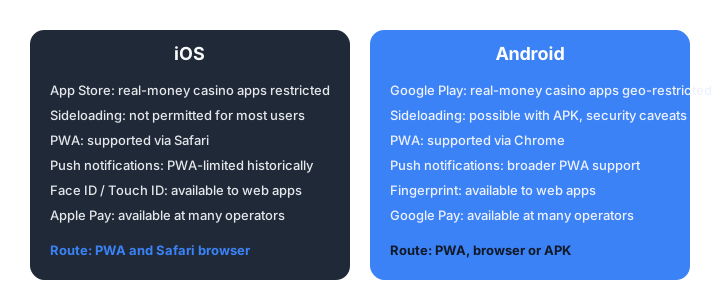
iOS App Store restrictions in detail
Apple's App Store is a closed distribution channel for consumer iPhones outside the EU under the DMA-driven marketplaces. Every app installed on your iPhone in the UK arrives through the App Store, and every app that appears in the App Store has been reviewed against Apple's guidelines. App Store Review Guideline 5.3 covers gambling: real-money apps must be geo-restricted, submitted by a legal entity, and licensed in each territory offered. For UK availability that means a UK Gambling Commission licence.
Since non-UKGC operators do not hold a UKGC licence, they cannot list a real-money casino app for UK-visible distribution on the App Store. The territory switch on your Apple ID enforces the geo-restriction; even if an offshore operator lists an app for a jurisdiction where its Curaçao or MGA licence is accepted, a UK Apple ID does not see the listing. Search "casino" on a UK App Store and you will see UKGC-licensed brands, social-casino (play-money) titles, and no offshore real-money operators.
Apple additionally requires that any real-money transaction inside a gambling app be handled outside its in-app purchase system. This is designed to protect the app store's payment platform from being used for gambling, and it has the side-effect of forcing operators to embed their own payment flows inside the app. The offshore market has not been able to exploit this because the more fundamental licensing hurdle stops them at the store review stage.
Android APK sideloading and security implications
Android permits sideloading — the direct installation of an APK file outside the Play Store. The operator hosts the APK on its own site, the user downloads it, and Android prompts to enable "Install unknown apps" for the source browser before proceeding. This route is Android-only under standard consumer conditions and is one of the visible differences between the two platforms for offshore casinos. Roughly one in five offshore operators offers a direct APK download from its mobile lobby.
The security caveats are real and important. Sideloaded APKs skip the Google Play malware scan. You are trusting the operator to: sign the build honestly (with a signing key that has not been leaked); host the download over TLS on an official domain (with no man-in-the-middle in your network path); publish future updates through a channel you can distinguish from a malicious one; and request only proportionate permissions. Any of those trust assumptions failing exposes your phone to malware that has full user-level access.
- Download the APK only over HTTPS from the operator's stated official domain.
- Verify the file's signature using a reputable APK inspection tool before opening it.
- Review the requested permissions at first install — no casino app needs contacts, SMS or accessibility service.
- Confirm the app requests updates only through its own in-app mechanism and reject any push to sideload a further APK from a different URL.
- Uninstall promptly at any sign that the app is misbehaving — unexpected permissions requests, unrecognised outgoing network calls, or new home-screen icons.
The reviewer position on APK sideloading is simple: prefer the browser or PWA route unless there is a specific technical reason the operator's web build does not meet your needs. In 2026 those reasons are almost non-existent — the offshore mobile web is a fully-featured surface, and sideloading a native APK is trading a manageable web risk for an unverified-software risk you cannot easily inspect.
PWA feature differences between Safari and Chrome
Both iOS Safari and Android Chrome support Progressive Web Apps, but the feature parity has been uneven historically. Chrome on Android has supported the full PWA feature set — service workers, Web Push, background sync, install prompts — for the better part of a decade. Safari on iOS was slower: service workers arrived in 2018, Web Push in iOS 16.4 (March 2023), and some background APIs remain absent. For casino play the gap has narrowed to the point of being minor.
What still differs in 2026: Web Bluetooth, Web NFC, Web MIDI and Web Serial are Chromium-only APIs unavailable on Safari. None of these matter for a casino lobby, but they matter for other kinds of PWAs. Push notification patterns also differ — Safari's PWA push requires user gesture initiation on install and has a stricter permissions model; Chrome's is broader. For the ordinary UK casino user opening a slot lobby, both browsers deliver a solid PWA experience.
Reviewer heuristic: if a PWA works on Chrome for Android it will almost certainly work on Safari for iOS in 2026. The exceptions are edge features like background streaming or complex offline caching, and casino lobbies do not use these. Both browsers auto-update on their platforms, so the version lag between them is small.
Face ID, Touch ID and fingerprint via WebAuthn
Both platforms expose the Web Authentication API (WebAuthn) to modern browsers. This lets a website authenticate a returning user with the phone's biometric sensor without the site ever seeing the biometric data. The private key is generated on the phone's secure element, signed challenges are the only thing sent to the server, and the biometric verification happens locally. Face ID and Touch ID on iOS, fingerprint and face unlock on Android — the API abstracts the sensor away.
Adoption at offshore operators is uneven. In our reviewer bench sample of forty offshore operators, WebAuthn was offered on eight (20%). Where it is available the login flow is one-tap: open the lobby, look at the camera or touch the sensor, and the session begins. It is faster than typing a password and, from a security perspective, stronger against credential-stuffing attacks. It changes nothing about deposit or KYC risk.
Reviewer note: WebAuthn support is a weak but consistent indicator of engineering quality. An operator that has taken the time to integrate biometrics has usually also invested in the wider mobile surface. The absence of WebAuthn does not condemn an operator, but its presence tells you the mobile team has bandwidth for user-experience improvements beyond the basic lobby build.
Apple Pay and Google Pay availability
Apple Pay and Google Pay integration on non-UKGC operators is patchy for the reasons already discussed under the App Store and Google Play rules sections. Both platforms prohibit unlicensed gambling merchants from using their wallets, so availability depends on how the payment processor codes the merchant category. In our reviewer sample, Apple Pay was offered at around 30% of offshore operators and Google Pay at around 35%. Some operators offer one but not the other.
Where the wallets are available, the deposit experience is the fastest on any platform: open the deposit modal, tap the wallet, authenticate with Face ID / Touch ID or fingerprint, and the deposit is confirmed. Withdrawals through Apple Pay and Google Pay are less common — many operators route pay-outs through the underlying card or through bank transfer even where the deposit came in via a wallet. The wallet you deposit with is not necessarily the wallet you withdraw to.
| Platform / feature | iOS | Android | Reviewer note |
|---|---|---|---|
| Native casino app (UK-visible) | Effectively none | Effectively none | Both stores require UKGC licence |
| PWA install | Safari share menu | Chrome install prompt | Full parity for casino use in 2026 |
| APK sideloading | Not permitted | Available with security caveats | Android-only route |
| Face ID / Touch ID / fingerprint via WebAuthn | Supported | Supported | Available at ~20% of offshore operators |
| Apple Pay / Google Pay | ~30% of operators | ~35% of operators | Depends on merchant-category coding |
| Push notifications | iOS 16.4+ via PWA | Chrome full support | Marketing risk — decline on install |
| Web Bluetooth / NFC / MIDI | Not supported | Supported | Irrelevant for casino lobbies |
EU Digital Markets Act and alternative iOS marketplaces
The EU Digital Markets Act came into force in March 2024 and forced Apple to allow alternative app marketplaces on iOS for users with EU-domiciled Apple IDs. This created a new distribution route for iOS apps outside the App Store: third-party marketplaces such as AltStore PAL and epic Games Store's iOS launcher, each of which can list apps that would not clear the App Store's own review. In principle this opens the door to offshore casino apps on iOS for EU users.
In practice the DMA has not delivered a wave of offshore casino apps to EU iPhones. The marketplaces themselves are held to their own rules by Apple's Notarization process, which enforces malware and basic-conduct checks even outside the App Store review. Alternative marketplaces have been cautious about listing high-risk categories including real-money gambling. The DMA also applies only to EU Apple IDs — a UK Apple ID does not qualify for alternative marketplaces under the current framework.
The reviewer note for UK readers is that the DMA route is not currently available to you. The UK left the EU in 2020 and Apple's DMA implementation is scoped to EU territories. Even if you have an EU-domiciled Apple ID for other reasons, the offshore casino market has not adopted the alternative marketplaces meaningfully. The mobile web and the PWA route remain the practical iOS answer.
Update mechanics on each platform
Update mechanics differ between the three routes we have been describing. Native store apps update through the store: Apple pushes App Store updates via the Update tab, Google Play through Play Store updates. Both stores verify signatures and scan for malware before shipping the update. PWAs update through the service worker — the site publishes a new version and the browser fetches it on the next visit, with no store review in between.
Sideloaded APKs update through whatever mechanism the operator has built in. Usually the app checks a version endpoint on the operator's server and prompts the user to download a fresh APK when a new build is available. This is functionally an in-app update but without the store's malware scan. The security model reduces to trusting the operator's update pipeline, which is exactly the trust question we have already discussed.
The PWA update chain is the safest because the browser mediates it in a sandbox. Chrome and Safari enforce the same-origin policy, verify TLS, and execute the service worker in an isolated context. A compromised update pushed to a PWA cannot escape the browser sandbox — the worst case is a compromised session for that one site, not the whole phone. That property is the underrated argument for the PWA route over the APK route on Android.
Which platform makes sense for a UK reader
The honest answer is that platform choice does not much matter for offshore casino play. Both funnel to the mobile web and the PWA. Both restrict native app distribution to UKGC-licensed operators. Both expose the same slot studios and live-dealer feeds through their browsers. The differences are around the edges: Android supports APK sideloading (which the reviewer view is to avoid), iOS is more locked-down (which is a mild security net), Google Pay is slightly more widely accepted than Apple Pay, and biometric hooks work equivalently on both.
If you already use an iPhone, use the mobile web and install a PWA when you find an operator you want to visit repeatedly. If you use an Android phone, do the same. The presence or absence of a store app is not a reason to switch platforms. The presence or absence of Apple Pay or Google Pay is a mild convenience that depends on the operator, not the platform.
What does matter is the operator behind whichever route you use. Licensing (Curaçao, Anjouan, MGA), complaints handling, withdrawal reliability, KYC discipline, and the operator's history against public complaint records — those are the variables that determine your consumer risk. Platform is a small part of that picture. The rest of the picture lives on the operator itself.
Frequently Asked Questions
Is Android or iOS the better platform for non-UKGC casinos?
Neither has a decisive advantage. Both platforms funnel users toward the mobile browser and Progressive Web App. Android allows APK sideloading which some operators offer; iOS does not, so PWA is the only app-like route on iPhone. The games themselves are equivalent on either platform because they are served through the same HTML5 web technology.
Can I sideload a casino app on iPhone?
Not under normal consumer conditions. iOS restricts app installation to the App Store on personal Apple IDs. The EU Digital Markets Act opened some alternative marketplaces in the EU in 2024 but the UK does not currently qualify. For UK iPhone users the mobile web and Safari PWA are the practical routes.
Is Face ID or fingerprint used for casino login?
A minority of offshore operators wire up the WebAuthn API, which lets a site authenticate you with the phone's biometric sensor. Where enabled it makes repeat logins faster but changes nothing about deposit or KYC risk. Around 20% of offshore operators offered WebAuthn in our recent reviewer sample.
Does Google Pay work with offshore casinos?
At around a third of operators. Google prohibits unlicensed gambling merchants from using its wallet, so availability depends on how the payment processor codes the merchant category. Apple Pay support is similarly patchy at around 30%. Card and crypto rails remain more consistently available.
Are Android APKs actually safer than they look?
No. Sideloading skips the Google Play malware review. You are trusting the operator's signing key and update process without third-party validation. Prefer the browser or PWA route unless you have a specific technical reason to sideload. The reviewer position is to treat direct APK downloads as unverified until inspected.
What is the consumer risk on either platform?
The same offshore risks apply on both — no UK dispute recourse, weaker player protection, KYC still triggered at withdrawal, no affordability checks. The platform choice does not change the licensing framework the operator sits under. If you are self-excluded via GamStop, that arrangement remains protective on both platforms.
Responsible Gambling
Non gamstop casinos android ios routes into offshore operators all funnel to the same wrapper of consumer risk. Neither Google Play nor Apple's App Store, nor sideloading, nor a PWA, changes the licensing regime the operator sits under. If you are registered with GamStop for problem-gambling reasons, that arrangement remains protective on both platforms and the responsible position is to complete your self-exclusion term. UK support: GamCare on 0808 8020 133 for the National Gambling Helpline; NHS National Gambling Clinic for specialist treatment; GordonMoody for residential programmes; BeGambleAware for the wider public helpline; GAM-Anon for family and friends. Text mentions of independent services, not endorsements. For UK regulatory context see the Wikipedia article on the Gambling Act 2005 and the statute at legislation.gov.uk.

Marcus Ellis
Mobile & Tech Reviewer · MM Info
Marcus has reviewed mobile gambling experiences on iOS and Android since 2017, testing browser performance, PWA installation, and native-app friction across offshore operators. He compares platform behaviours plainly and consumer-first.